Realistic dialogue in fiction doesn’t just mimic real conversation. It creates the illusion of it. Strong dialogue reveals character, advances plot, and carries subtext without sounding staged or self-conscious. It feels spontaneous and inevitable, as though these are the only words these particular people could have said in that moment. Their inner worlds, made real.
In this guide, we’ll look at what makes dialogue sound real, why so much fictional dialogue fails, and how you can craft speech that feels alive without sacrificing narrative control. I’ll include occasional examples from Mothtown and Composite Creatures to show how these principles work in practice.
What makes dialogue sound real?
Realistic dialogue is shaped by five core principles. Good, strong dialogue should:
- reflect character voice
- contain subtext
- have rhythm and variation
- serve narrative purpose
- avoid unnecessary filler
Real dialogue is not just real conversation. It is sculpted speech shaped by narrative intent.
In life, we ramble. We repeat ourselves. We hedge. I know I certainly do. But done too much on the page, that kind of fidelity produces boredom. Fictional dialogue must be selective, compressed, and purposeful, but it must feel unforced.

Let’s untangle those words, shall we?
The 7 core techniques for writing realistic dialogue
1. Give every character a distinct voice
If you remove dialogue tags, can you still tell who’s speaking?
Voice is not about gimmicks or exaggerated quirks. It’s borne from:
- education and class background
- emotional restraint (or lack of it)
- sentence length and rhythm
- vocabulary choices
- what the character avoids saying
In Mothtown, characters often circle trauma obliquely. A line like:
“It’s not the noise that bothers me,” she says. “It’s the quiet after.”
This reveals restraint and avoidance. The character does not name the source of fear; it’s displaced. That displacement is part of her voice.
By contrast, a character in Composite Creatures might be more confrontational:
“You can call it grief if you want. I call it cowardice.”
Short, declarative, cutting. Rife with insinuation and accusations, yet all remaining unsaid. Voice signals psychology, and reveals so much about both subconscious and conscious intent.
2. Cut the filler (but keep the illusion)
Go to a café or train station and you’ll hear that real spoken conversation is full of:
“umm”
“well”
“you know”
But on the page, too much of this slows momentum, and weakens both character and narrative movement.
Raw version:
“Well, I mean, I just thought that maybe, you know, we could talk about it?”
Edited:
“I thought we should talk.”
The second line is cleaner and more powerful. However, strategic hesitation can reveal character:
“I thought we should… I don’t know. Forget it.”
The break matters because it signals doubt. Filler becomes meaningful when it exposes something psychological.
If your dialogue feels stiff, it may not need more realism. It may need less clutter.
3. Use subtext — write what isn’t said
Subtext is the engine of believable dialogue.
It is the gap between what a character says and what they mean.
For example, a character might say:
“You don’t have to stay.”
On the surface, this is permission. Underneath, it is a plea not to leave.
Subtext emerges through:
- context
- conflict
- power imbalance
- emotional stakes
If two characters want the same thing, the scene has no friction. But if one wants reassurance and the other wants escape, dialogue becomes charged.
Compare:
Flat:
“Are you angry?”
“Yes, I’m angry.”
With subtext:
“Are you angry?”
“I’m tired.”
The second exchange carries tension. Anger is displaced into exhaustion. The reader infers what is withheld.
Subtext is not decoration; it is structure. It allows dialogue to operate on more than one level at once.
4. Keep dialogue goal-oriented
Every exchange should shift something. It might be knowledge, power, emotion, direction.
Each line of dialogue should propel either the characters or the plot. Think:
- does this conversation change the relationship?
- does it reveal new information?
- does it intensify or complicate conflict?
If two characters speak for a page and nothing alters, the scene likely belongs in summary.
Dialogue should not simply fill space between action. It is action.
5. Vary rhythm and sentence length
This is when my inner poet comes out to play.
The human mind needs music and variance, because monotony kills realism. Conversation always has rhythm, whether it’s interruptions, accelerations, fluctuating pitch, or silence.
Long speech:
“You think this is about what happened that night, but it isn’t. It’s about every night since.”
Followed by:
“Stop.”
The abruptness creates impact.
Short exchanges can feel combative:
“Don’t.”
“Make me.”
Longer sentences can feel defensive or explanatory.
Read your dialogue aloud. If every line lands with the same cadence, revise for variation. Rhythm carries emotional texture.
6. Use dialogue tags and action beats effectively
“Said” is almost invisible to readers. That is its strength.
Overwriting tags distracts:
“I hate this,” she exclaimed angrily.
The adverb explains what the dialogue already conveys.
A better way, would be to combine the dialogue with an action that demonstrates how she feels.
“I hate this.”
She pushes the glass away.
Think ‘show not tell’.
7. Avoid info-dumping in dialogue
One of the most common mistakes is having characters share everything about themselves and their histories through speech:
“As you know, we’ve been sisters for thirty years, ever since Mother died in 1995…”
Instead, embed exposition in tension and action:
“You left me to deal with her funeral alone.”
“I was nineteen.”
“So was I.”
This example shows an argument, and comes alive in the mind of a reader. You can practically hear the raised voices, the stern tones. And what’s even better, is that the history is implied, not lectured. It creates the ghost of an emotional wound, and this is what carries the information.
If dialogue exists solely to transmit background facts, it sounds artificial. Let conflict reveal context.
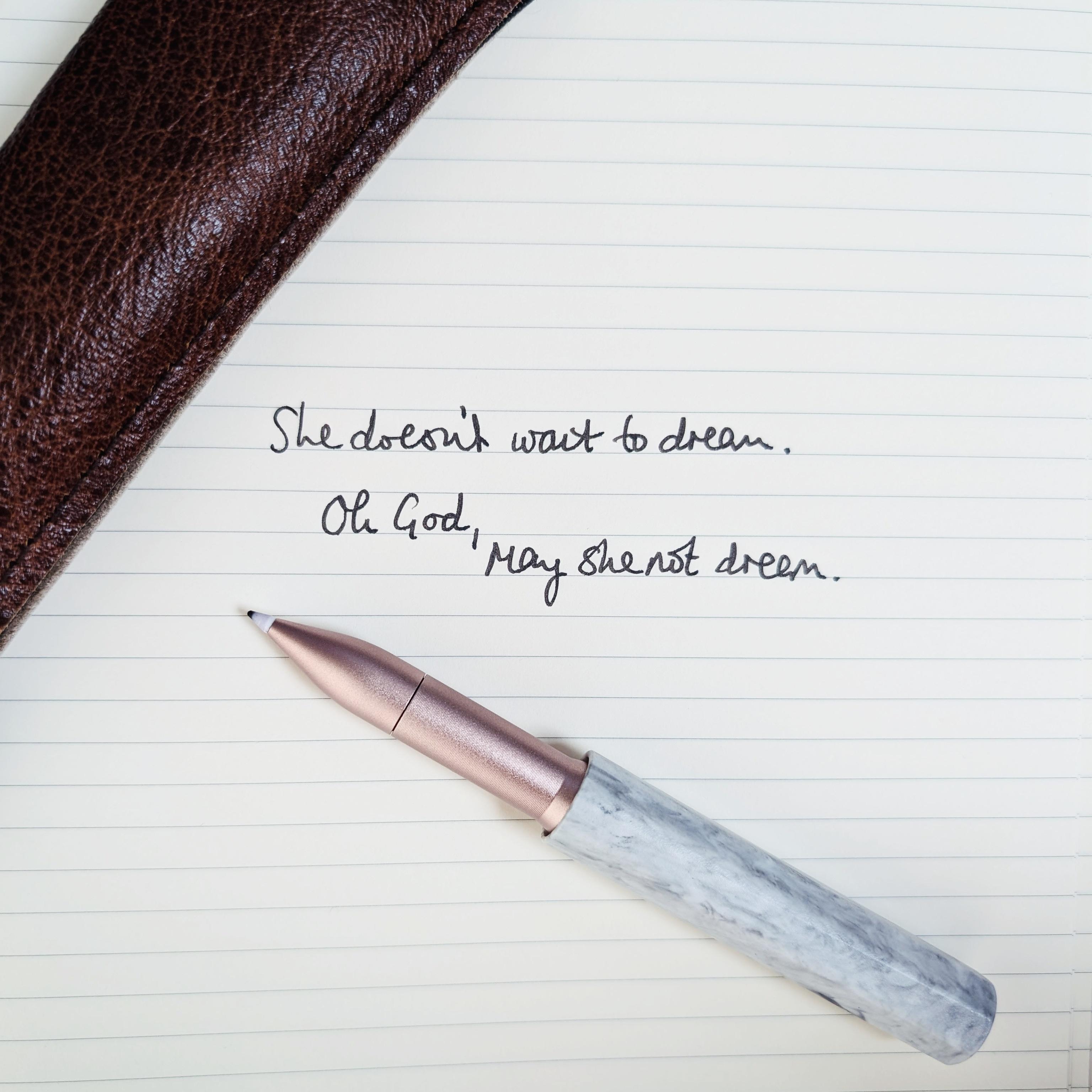
Of course, it’s not all about spoken dialogue. Remember internal monologues, too.
Common dialogue mistakes (and how to fix them)
1. Stiff or overly formal speech
Unless your character is deliberately formal, excessive politeness feels unnatural.
Fix: Shorten sentences. Remove unnecessary qualifiers.
2. All characters sound the same
This usually means the author’s voice is dominating, not the characters’.
Fix: Adjust rhythm, vocabulary, and emotional restraint for each speaker.
3. On-the-nose emotion
“I’m devastated and heartbroken.”
Real people often understate.
Fix: Replace emotional labelling with behaviour.
4. Too much small talk
Greetings and pleasantries rarely need to be shown unless they reveal something. Readers assume it’s happened, but we don’t need to hear about it. Just like toilet visits. Or having a shower.
Fix: Enter the scene late. Leave early.
5. Overuse of adverbs in tags
Use action to demonstrate how the character feels, rather than adverbs. How they put a cup down, how they touch their face, how they breathe.
Avoid:
“She said bitterly.”
“He replied sarcastically.”
Fix: Let the dialogue and context carry tone.
Dialogue vs real conversation
Real conversation is messy. Fictional dialogue is sculpted.
In life:
- we repeat ourselves.
- we speak without direction.
- we drift.
I know I certainly do! But in fiction:
- speech is compressed.
- exchanges are intentional.
- silence is strategic.
Dialogue is not documentary realism. It is narrative construction.
In Composite Creatures, conversations often carry ideological weight — who has authority to define what is ‘normal’ in this uncanny new world? Who names experience, who is believed? Dialogue becomes a site of power.
When a character says:
“That’s not what happened”
… they aren’t merely correcting a detail. They are contesting control over reality.
Dialogue is never neutral.
How to practice writing better dialogue
- Conflict-only exercise
Write a scene where two characters want opposing outcomes. Remove all exposition. Let tension reveal context. - Subtext rewrite
Take a blunt exchange:
“I don’t love you anymore.”
Rewrite it without stating the emotion directly.
- Voice differentiation
Write the same apology from three characters: one defensive, one ashamed, one manipulative. - Cut 30%
Take a dialogue-heavy scene and cut 30% of the words. Notice how much stronger it becomes.
Practice sharpens instinct.

So many words. So many conversations.
FAQ: writing realistic dialogue
Should dialogue be grammatically correct?
Not always. Characters may fragment sentences or use slang. However, readability matters. Break grammar deliberately, not carelessly
How long should dialogue be?
As long as necessary to shift the scene — and no longer. If nothing changes, shorten it.
Can you write accents in dialogue?
Use sparingly. Suggest accent through rhythm and word choice rather than heavy phonetic spelling, which can become distracting.
How much dialogue is too much?
If readers lose sense of setting or action, you may need more grounding. Dialogue should interact with physical context.
Dialogue revision checklist
Before you finalise a scene, ask:
- does each character sound distinct?
- are sentence lengths and rhythms varied?
- is there subtext?
- does the exchange shift something?
- have I cut unnecessary filler?
- is exposition embedded rather than declared?
- are dialogue tags unobtrusive?
- is formatting clean and consistent?
If the answer to several of these is no, it’s time to edit.
Final thoughts
Dialogue that sounds real is not accidental. It is shaped through attention to voice, tension, rhythm, and restraint.
In both Mothtown and Composite Creatures, dialogue often carries what narration cannot: denial, displacement, resistance, longing. It exposes fractures in memory and power. It stages conflict without always resolving it.
That is the paradox of effective fictional speech. It feels spontaneous — but it is anything but.
When dialogue works, readers stop noticing the craft. They hear the characters instead.
And it’s that illusion, carefully built, sentence by sentence, that makes fiction breathe.
Good luck, world-builders. 😊
 Caroline Hardaker Author